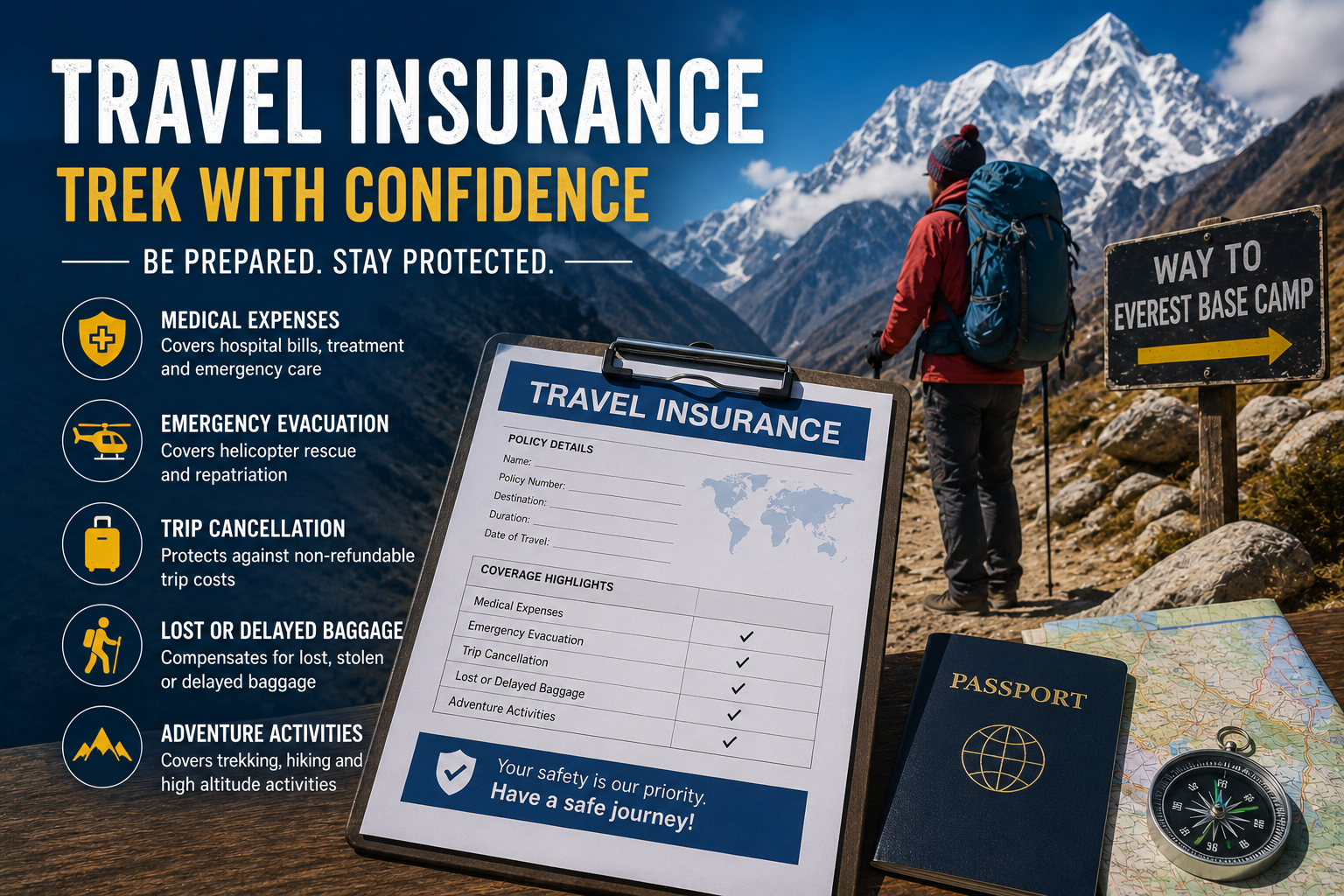
Nepal Travel Insurance: The Complete Trekker's Guide (2026)
A cheap travel policy bought at checkout almost never covers what a Himalayan trek actually needs. This guide breaks down exactly what your Nepal trekking insurance must include — altitude limits, helicopter evacuation, and how it now ties directly into the 2026 permit system — plus real rescue costs and a checklist for choosing the right policy.
Nepal Travel Insurance — At a Glance (2026)
Legally required: No blanket national law, but practically mandatory — agencies and permit offices require proof | Minimum altitude coverage: At least 6,000m for most major treks, more for trekking peaks | Helicopter evacuation cost without insurance: USD $3,000–$10,000+ | Typical policy cost: USD $90–$250 for a 2–3 week trek | Non-negotiable clause: Explicit helicopter evacuation coverage, not just 'emergency medical'
Every year, trekkers arrive in Kathmandu with travel insurance they bought in ten minutes online — and every trekking season, some of them find out the hard way that their policy doesn't actually cover the mountain they're standing on. This isn't a rare edge case. It's one of the most common and most expensive mistakes made in Nepal trekking, and it's entirely avoidable with about fifteen minutes of careful reading before you buy.
This guide covers exactly what Nepal travel insurance needs to include, what it costs, how it now connects directly to the permit system, and what actually happens on the ground when a policy gets used for real. If you haven't yet sorted your trekking permits or guide requirement, it's worth reading this alongside those, since insurance now has to be sorted before either of them can be finalized.
What Is Nepal Travel Insurance, and Why It Matters
Nepal travel insurance, in the trekking context, means a policy specifically designed to cover high-altitude activity — not a generic travel policy bought for a beach holiday. The distinction matters because Nepal's trekking routes climb well past the altitude ceiling built into most standard travel insurance, into terrain with no roads, patchy phone signal, and hospitals that are hours away by helicopter, not ambulance. The single most important thing a Nepal trekking policy needs to do is guarantee that if something goes wrong at 4,500m, someone else is paying for the helicopter — not you, on the spot, in cash.
Is Travel Insurance Legally Required in Nepal?
Technically, no — Nepal has no blanket national law requiring every foreign visitor to carry travel insurance. In practice, it's close to mandatory. Since 2026, proof of insurance covering high-altitude medical treatment and helicopter evacuation is required before a TIMS card or Restricted Area Permit will be issued for most major routes. On top of that, essentially every reputable trekking agency — Evertrek Nepal included — will not confirm a trek without seeing a valid policy first. So while there's no police checkpoint asking to see your insurance card on the street, there's effectively no way to legally start a guided trek on a national park or conservation area route without one.
Why Standard Travel Insurance Isn't Enough
The policy that came free with your credit card, or the cheap add-on you clicked through at checkout on a flight booking site, is built for a different kind of trip. Most standard travel insurance excludes coverage above 3,000–4,000m, and many exclude "hazardous activities" like trekking altogether unless you specifically add it. Everest Base Camp sits at 5,364m. Kala Patthar, the classic EBC viewpoint, is 5,545m. Both are well above what a standard policy will pay out for.
Read the Altitude Clause, Not Just the Headline Coverage
A policy can advertise "$500,000 in emergency medical coverage" and still refuse to pay a single dollar for a rescue at 5,000m, because the altitude exclusion sits in the fine print, not the marketing copy. Call your provider directly, ask them to confirm in writing that your specific route's maximum altitude is covered, and don't rely on assumption.
What Your Nepal Trekking Insurance Must Cover
- Helicopter evacuation, explicitly named — not just "emergency medical transport," which some providers interpret as ground ambulance only
- Altitude coverage that exceeds your route's highest point by at least 1,000m, to account for side trips, viewpoint detours, or route changes
- Emergency medical treatment for altitude sickness (AMS), including High Altitude Cerebral Oedema (HACE) and High Altitude Pulmonary Oedema (HAPE), both of which can become life-threatening within hours
- Adventure activity / trekking cover, since some general policies exclude hiking above a certain elevation as a "hazardous activity" unless specifically added
- Trip cancellation and interruption, in case illness, weather, or a family emergency forces a change of plan before or during the trek
- Repatriation coverage, for the rare but serious case of needing to return home for ongoing treatment
- Baggage and gear coverage, useful given how expensive replacing trekking gear can be in a remote trailhead town
Altitude Coverage by Popular Trek
| Trek | Highest Point | Altitude | Minimum Insurance Coverage to Buy |
|---|---|---|---|
| Poon Hill | Poon Hill viewpoint | 3,210m | 4,000m+ |
| Mardi Himal | Mardi Himal Base Camp | 4,500m | 5,500m+ |
| Annapurna Base Camp | ABC | 4,130m | 5,000m+ |
| Langtang Valley (Tserko Ri) | Tserko Ri | 4,984m | 6,000m+ |
| Manaslu Circuit | Larkya La Pass | 5,106m | 6,000m+ |
| Everest Base Camp | Kala Patthar | 5,545m | 6,000m+ |
| Annapurna Circuit | Thorong La Pass | 5,416m | 6,000m+ |
| Trekking peaks (Island Peak, Mera Peak) | Summit | 6,160m–6,476m | 6,500m+ with mountaineering rider |
As a rule of thumb: buy coverage to at least 1,000m above your route's official highest point. Weather, itinerary changes, and optional side trips regularly push trekkers higher than the standard route description, and the cost difference between a 5,000m and 6,000m policy is small compared to the protection gap it closes.
Helicopter Evacuation Costs in Nepal
Helicopter rescue in Nepal is not cheap, and the price climbs with altitude, distance from Kathmandu, and weather conditions on the day. These figures reflect real evacuation costs reported across the Everest, Annapurna, and Langtang regions in recent seasons.
| Evacuation From | Approximate Cost (USD) |
|---|---|
| Namche Bazaar to Kathmandu | $3,000–$5,000 |
| Gorak Shep / Kala Patthar / Everest Base Camp to Kathmandu | $6,000–$10,000+ |
| Manang / Thorong La area to Kathmandu (Annapurna Circuit) | $4,000–$8,000 |
| Kyanjin Gompa / Tserko Ri area to Kathmandu (Langtang) | $3,500–$6,000 |
| Kathmandu hospital treatment following evacuation | $1,000–$3,000 additional |
Without Insurance, This Bill Is Yours — Before Treatment Begins
Nepali hospitals and helicopter operators generally require payment upfront or a guaranteed payment confirmation before a rescue is dispatched or treatment begins. Without valid insurance, that means arranging several thousand dollars in cash or card payment from a remote village, in the middle of a medical emergency. A policy with direct, cashless payment to the provider removes this problem entirely.
How Much Does Nepal Trekking Insurance Cost?
| Coverage Level | Estimated Cost (USD) | Notes |
|---|---|---|
| Standard high-altitude trekking policy (up to 6,000m) | $90–$180 | Suitable for most teahouse treks including EBC, ABC, and Annapurna Circuit |
| Extended high-altitude / trekking peak coverage (6,500m+) | $150–$250 | Needed for Island Peak, Mera Peak, and similar climbs |
| Dedicated evacuation-only membership services | $300–$500 per trip or annual membership | No altitude cap; often used alongside a standard medical policy rather than instead of one |
Prices vary by provider, traveler age, trip length, and home country. What doesn't vary much is the relationship between premium and risk: the difference between an adequate policy and an inadequate one is often under USD $50 — a small amount to save on the one purchase most likely to matter if your trip goes wrong.
Types of Insurance Providers to Consider
We don't endorse a single provider — the right choice depends on your nationality, age, and route — but it's worth understanding the broad categories trekkers typically choose from.
- Adventure-travel specialists: Providers built specifically around trekking, climbing, and high-altitude activity, generally offering coverage up to 6,000m as standard with trekking peak add-ons available.
- General travel insurers with adventure riders: Mainstream travel insurance brands that require you to specifically add high-altitude trekking or hazardous-activity cover — easy to overlook if you're not reading closely.
- Dedicated evacuation and rescue services: Membership-style services focused purely on medical evacuation with no altitude ceiling, often used by expedition teams alongside a standard medical policy rather than as a replacement for one.
- Country-specific insurers: Several national providers in the UK, Europe, Australia, and India offer trekking-specific add-ons, which can be worth comparing against international options for cost and claims-handling familiarity in your home country.
How Insurance Ties Into Nepal's Permit System
As of 2026, proof of travel insurance covering high-altitude medical treatment and helicopter evacuation is a formal part of the permit process for TIMS cards and Restricted Area Permits. A policy that doesn't clearly state evacuation coverage can be rejected at the point of permit issuance, which means insurance now needs to be sorted before, not after, your permits and guide are finalized. For the full breakdown of which permits apply to your route, see our Trekking Permits Guide.
What Actually Happens During an Evacuation
Understanding the actual sequence of events helps explain why insurance details matter so much in the moment, rather than after the fact.
- Your guide notices or you report symptoms — persistent headache, nausea, confusion, or breathing difficulty — and checks your oxygen saturation with a pulse oximeter
- If symptoms are mild, the first response is immediate descent, which resolves many cases of altitude sickness on its own within hours
- If symptoms are serious or don't improve, your guide contacts the trekking agency's Kathmandu office, who begins coordinating a helicopter evacuation
- The agency contacts your insurance provider directly to confirm coverage and, where possible, arrange cashless payment guarantee before the helicopter is dispatched
- A helicopter typically arrives within one to three hours, depending on weather conditions and the specific location
- You're flown to a hospital in Kathmandu (or the nearest appropriate facility) for treatment, with your agency and insurer continuing to coordinate on your behalf
"The best evacuations are the boring ones — where the insurance is already confirmed, the paperwork is already sent, and the only thing left to do is fly. The bad ones are when we're on the phone arguing about coverage while someone is getting sicker at 5,000 metres."
Common Insurance Mistakes Trekkers Make
- Assuming a credit card's built-in travel insurance covers high-altitude trekking — it almost never does
- Buying coverage to exactly your route's highest point, with no buffer for side trips or itinerary changes
- Not confirming in writing that helicopter evacuation is explicitly included, rather than assuming it's covered under general "emergency medical"
- Purchasing a policy after arriving in Nepal from a provider that doesn't support post-departure sign-up (most require purchase before you leave home)
- Forgetting to declare trekking or hiking as an activity on a general travel policy, triggering an exclusion clause later
- Not sharing a copy of the policy with your trekking agency in advance, so any coverage gaps are caught before departure rather than during an emergency
How to Choose the Right Policy: A Checklist
- Does it explicitly name helicopter evacuation as covered, not just "emergency medical transport"?
- Is the altitude limit at least 1,000m above your route's highest point?
- Is trekking or hiking listed as a covered activity, not excluded as "hazardous"?
- Does it cover AMS, HACE, and HAPE specifically?
- What's the medical expense limit — ideally $100,000 or more for international trekkers?
- Can the provider pay the hospital or rescue operator directly (cashless), or do you need to pay upfront and claim later?
- Does it include trip cancellation and interruption cover?
- Can you purchase it before you fly, and does it support the length of your trip including any planned extensions?
Frequently Asked Questions — Nepal Travel Insurance
Final Thoughts
Insurance is the one piece of trekking gear you hope never to use, which is exactly why it's the easiest thing to under-prepare. A policy that costs under $200 and explicitly covers your route's altitude and a helicopter evacuation is the difference between a stressful but manageable emergency and a genuinely dangerous financial and medical situation, thousands of metres from the nearest road. Once your policy is sorted, check our Trekking Permits Guide to confirm what else you'll need before departure.
About the Author

Raj Kumar Tamang
Crisis Manager, Evertrek Nepal
Rajkumar Tamang is the Crisis Manager at Evertrek Nepal, responsible for trekker safety, emergency response, and rescue coordination across the company's Himalayan trekking operations. He works closely with licensed guides, local rescue teams, and helicopter evacuation services to ensure every trekker's itinerary has a clear emergency plan behind it. Rajkumar writes about altitude sickness awareness, trail safety, insurance requirements, and what to do when things go wrong in the mountains, drawing on years of firsthand incident response experience across Langtang, Everest, Annapurna, and Manaslu.
We Review Your Insurance Before You Trek
Every Evertrek Nepal trekker's insurance policy is reviewed by our team before departure — we check altitude limits, evacuation coverage, and claims process, and flag any gaps before you're on the trail. Our Crisis Manager and guides coordinate directly with insurers during any emergency, so you're never negotiating coverage from a teahouse at 4,000m.
Quick Contact
Questions about this trek? Our team responds within a few hours.